
Corners and curves change how soil pushes on a wall, and can create weak points if they are treated as an afterthought.
Corners
- Sleeper walls need corner posts suited to the angle.
- Block walls need reinforcement that laps around the corner.
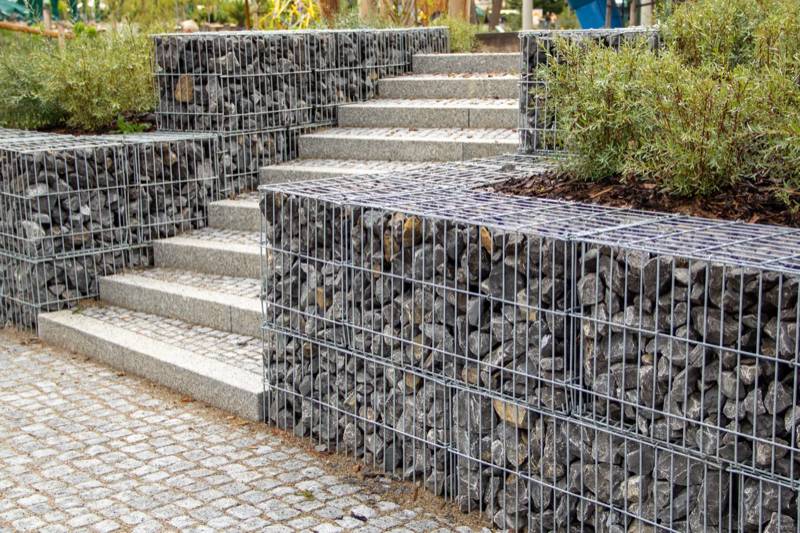
- Gabions are laced or joined so baskets act together.
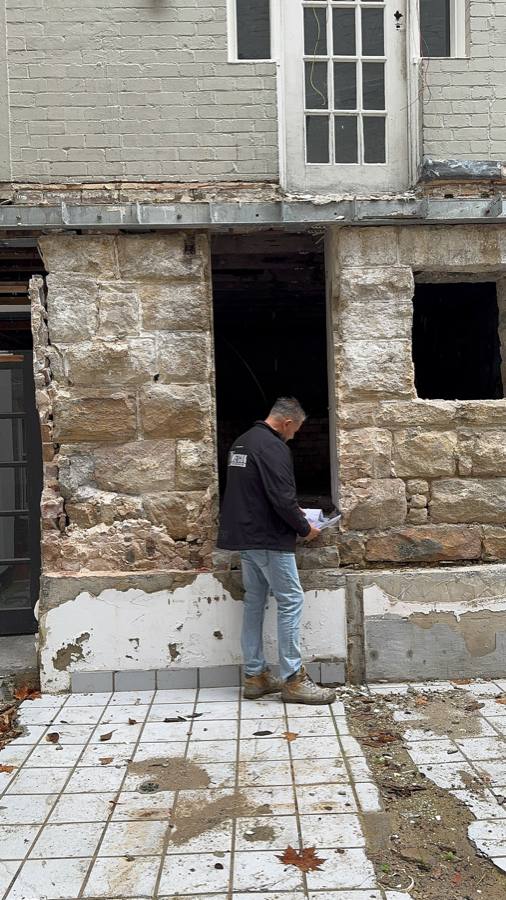
- Sandstone blocks are bonded rather than stacked with one straight joint.
Curves by material
- Segmental block suits smooth curves.
- Gabions can form gentle curves in short angles.
- Sleepers make faceted curves.
- Stone can follow most shapes, with more cutting.
Watch the drainage
Water collects in inside corners. Keep the fall in the ag pipe and give it an outlet.
Set out first
Mark the curve with paint and check mower access, steps and fence lines before digging.
See steps in walls.
Set out around real use
Before settling on a shape, stand in the yard and test it. Can a mower turn at the corner? Does a gate open fully? Will a car door clear the capping? A curve that looks elegant on a plan may leave an awkward strip that nobody can use.
Fences, lights and capping
Curves also affect what goes on top. Panels must be short, capping must be cut and strip lighting has bend limits. Ask for these in the quote rather than adding them when the wall is finished.
Inside and outside corners
Soil pushes into an inside corner from two sides and drains into it as well. An outside corner can open up if the two sides move apart. Both need the wall tied properly through the turn, and neither should be the point where a drain simply stops.
Get your free retaining wall quote
Talk directly with Constantine, the builder. Free site assessment and an itemised quote within 24 hours.
Request Free QuotationFrequently Asked Questions
Are curves more expensive?
Usually, because of cutting, set-out and slower laying.
Why do corners crack?
Movement in two directions, poor reinforcement and trapped water are common causes.
Can a fence follow a curve?
Yes, usually in short straight panels.