
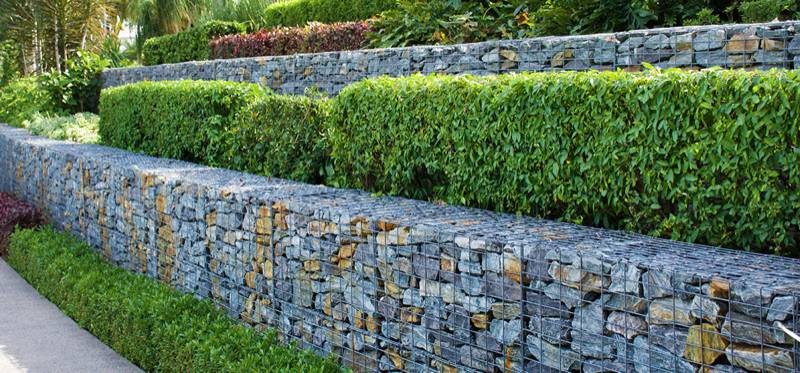
A gabion wall works by its weight. If it is too thin for its height it can slide or tip.
Why the base is wider
Pressure grows with depth, so the lower baskets do more. Taller walls are built with a wider base and narrower courses above.
Stepped front or stepped back
- Stepped front: creates ledges that can be planted.
- Stepped back: gives a flatter face and puts soil weight on the steps.
- Leaned back: a slight tilt into the slope improves stability.
What engineers check
- Sliding and overturning.
- Pressure on the ground.
- Overall slope stability.
- Basket mesh, rock size and density.
- Loads near the top.
Space to allow
Include the basket width, excavation and drainage zone, not only the face you see.
See the gabion walls guide.
A worked way to think about space
Suppose a wall has two rows of baskets. The bottom row may be wider than the top, and the machine needs space behind to place fabric and backfill. If the boundary is close, those widths can use most of the available land. Draw the base of the wall on the plan, not just its visible front face.
Do not skip the ground
A gabion is flexible, but it is heavy. Soft fill can settle under it and slopes can slide as one mass, with the gabion still intact. Good base preparation and a slope stability check are as important as the baskets.
Filling affects strength
Rock should be placed tightly with few voids, especially at the faces and corners. Bracing wires help stop baskets bulging. Poorly filled baskets weigh less, look uneven and settle later, so width alone does not make a good wall.
Get your free retaining wall quote
Talk directly with Constantine, the builder. Free site assessment and an itemised quote within 24 hours.
Request Free QuotationFrequently Asked Questions
Is there a standard ratio?
Rules of thumb exist, but slope, soil and load change the answer. Use a design.
Can a thin gabion be used as a feature?
Thin gabions on posts can be decorative, but that is not the same as holding back soil.
Can gabions be built on a boundary?
Yes if all of the wall and footing fits on your land, or with agreement.